Ferrari knows what it wants, and it’s clear the brand only does what works for it.
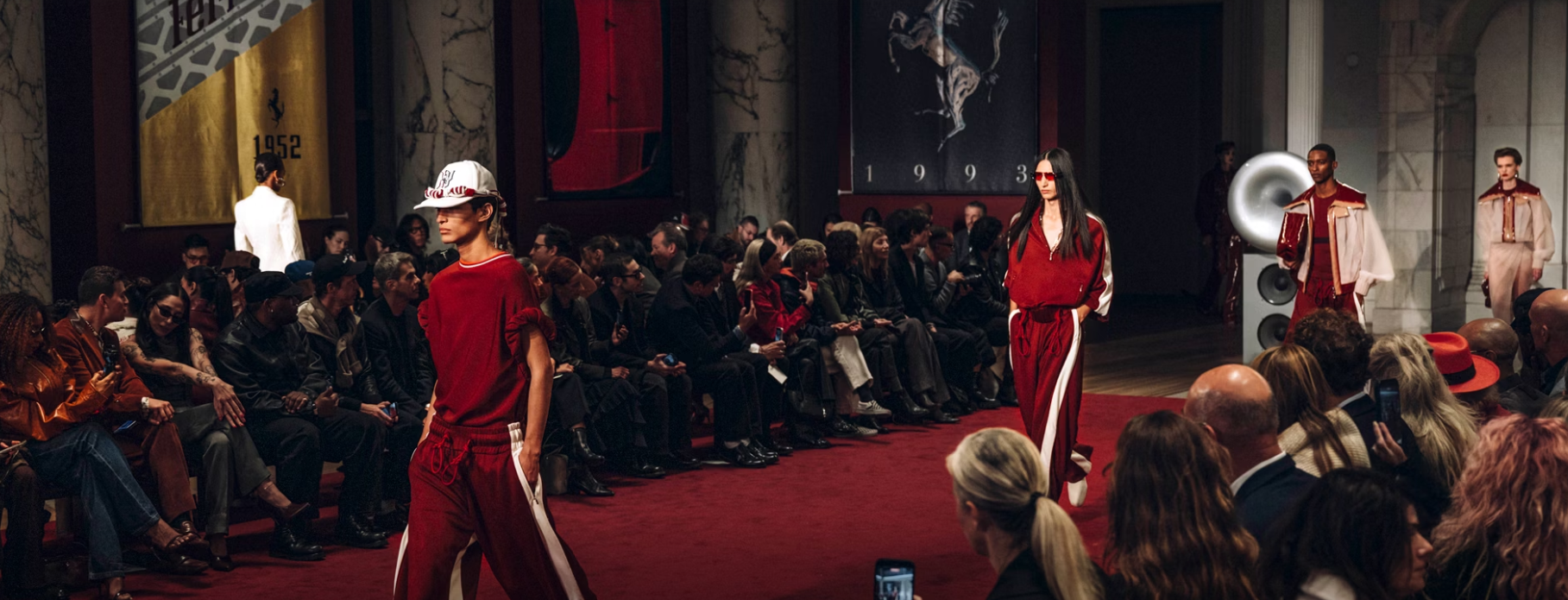
For Spring/Summer 2027, the Italian house brought its particular brand of luxury to New York for its first runway show in the city, with a collection built around movement, function, and a certain effortless cool.
At a resee of the collection, titled Crafting Identities, the clothes made an even stronger case for Ferrari’s growing fashion identity. Creative Director Rocco Iannone brought the world of Maranello, the Italian town where Ferrari has built its legendary sports cars since the 1940s, into dialogue with New York. Familiar forms took on new surfaces, materials, and expressions, resulting in a wardrobe that could move comfortably between long drives, casual days, and evening occasions, without looking too precious or overly considered.
Sporty, Functional, Upscale, Cool. The Ferrari customer is clearly as such defined, despite the diversity of looks. The collection leaned into what the client actually needs: comfort in sporty looks for long drives and casual days, with enough sophistication to carry through to dinner. It was modern, sporty, and cool, but still unmistakably luxurious.
There were sleek trousers and suiting for both women and men, elevated sportswear, and beautifully considered accessories that brought a little more personality to the clothes. The silhouettes were relaxed where they needed to be, but never careless. Rolled sleeves and belts pulled only halfway through their bows gave the styling a particularly convincing nonchalance, as though someone had gotten dressed for a joyride and just happened to end up looking this chic when they stepped out at the valet. Nothing felt overly fussed with, which is a particularly appealing part of the enthralling charm of Iannone’s universal language.
The details were worth a closer look:
Leather and fabric experimentation: Ferrari explored and expanded innovative ways of blending leather into fabric, with technical treatments that transformed familiar materials into something less expected. A particular standout in immaculate construction techniques, as one might expect from a legacy brand with a mechanical history to draw inspiration from.
Luxe accessories: Staple footwear included chic bustled leather shapes, branded sock boots, slinky clear layered socks with smoky stilettos, and Ferrari’s signature embellishments, alongside chunky chain necklaces, substantial silver hoops, heavy-duty branded zippers, and utterly cool tinted red or tortoiseshell Formula 1-ready sunglasses.
Devil in details: Ostrich-textured leathers, smooth and immaculate finishes, lacquered bright patent, and surprisingly sheer fabrics introduced texture without overwhelming the silhouette of each look.
Texture was a particular focus this season, and one of the more compelling developments came in the form of a black jacket that felt like the cool younger sibling to Iannone’s much-discussed leather-to-plaid design, created in only nine limited editions for Ferrari’s London boutique opening. Following that viral moment, the house appeared to revisit the same precise, time-consuming felting technique, this time transitioning black woven-texture leather into structured black canvas. The effect was considerably more darkly sleek and elegantly understated than its lived-in British predecessor, in a fitting nod to slick New York City, and no less impressive up close. This is the sort of technical innovation that can easily again become the entire conversation, yet Ferrari seems content to let the clothes speak for themselves, with equal design weight throughout the collection. A similarly blended red lacquered patent leather finish into buttery-smooth tan leather on coordinating menswear and womenswear looks stood out as another crowd favourite at the resee, continuing the house’s known tendencies for innovation through functional modern design, both in automotive and on the runway. Color coordination was especially aesthetically pleasing to immerse into, with shades blending easily into one another and often presented in a visually appealing ombré order. The collection felt cohesive without becoming repetitive. Half-tied waist details, slits for movement, and thoughtful proportions kept even the more polished looks from feeling restrictive.
There was also something distinctly Ferrari about the way the collection approached luxury. The clothes were designed to be worn and lived in, not simply admired. Precision and an understanding of line are fundamental to great design, whether shaping the body of a Ferrari or the silhouette of a beautifully constructed jacket. In both, every curve, proportion, and material choice should serve a purpose. Ferrari’s experience in the automotive world gives the house a particular understanding of what its customer expects from performance and comfort, and that thinking carries naturally into the wardrobe. After all, a beautiful object is considerably more interesting when it performs as well as it looks.
Crafting Identities: Ferrari’s Italian Legacy Sits Down to Dinner with New York
The presentation itself offered another perspective on the brand’s evolving identity. Staged at Jack Shainman Gallery in downtown Manhattan, the show was surrounded by nine historic Ferrari Yearbook covers, dating from 1949 to 1993, transformed into monumental tapestries by Italian textile house Rubelli in collaboration with Iannone.
Originally conceived as spaces for visual experimentation, the archival covers document how Ferrari has continually reconsidered its own image over the decades. Translated into textiles, the graphics acquired a new dimension, bringing the brand’s visual history into the same space as its latest collection. It was an exercise in heritage without the usual temptation to leave everything exactly as it was.
The exhibition connected Ferrari’s automotive origins in Maranello with its contemporary fashion ambitions, using craftsmanship as the common thread. The same philosophy of precision, experimentation, and material expertise that has defined the marque’s cars was now being expressed through clothing, textiles, and the surrounding space.
Ferrari described the idea behind the presentation simply: “No stasis. Only movement.”
A Fashion House With Nothing to Prove
Ferrari’s approach to New York has been equally deliberate. After previously showing in Milan, the house chose New York for its SS27 runway presentation, bringing its fashion universe to a city with its own distinct cultural energy. Rather than following the traditional fashion calendar simply because it’s expected, Ferrari seems more interested in establishing its own rhythm.
That independence is an interesting position for a brand whose name already carries so much recognition outside fashion. Founded by Enzo Ferrari, the marque’s history stretches from Italian motorsport to some of the world’s most coveted performance cars. Its fashion division, under Iannone, is a considerably younger undertaking, but one with an unusually rich design vocabulary to draw from. There is no need to borrow prestige from the fashion industry when the Ferrari name has spent decades building its own.
That confidence extends to the way Ferrari treats its customers. The New York show welcomed a considerable number of the house’s VVIP clientele, a refreshing presence alongside the usual fashion industry crowd. Ferrari made space for the people who actually live with the brand, rather than treating its runway presentation solely as an exercise in visibility. It’s a distinction that says quite a lot about its priorities, and perhaps an advantage of being Ferrari in the first place.
True Luxury Is in the Relationship
For all the industry’s conversation around exclusivity, Ferrari offers a rather convincing reminder of what true luxury service should actually look like. White-glove treatment, genuine attention, and a carefully considered guest list are not particularly revolutionary ideas, yet seeing them practiced with such consistency feels increasingly rare. Ferrari knows its customers, understands what matters to them, and makes the effort to ensure they feel that distinction. The rest of the luxury industry could stand to take a few notes.
The room itself made the point rather well. Ferraris were parked outside, while inside, clients mingled in head-to-toe Ferrari looks, many seemingly worn out of genuine affection for the brand rather than any obligation to dress for the occasion. Conversations moved easily between the clothes and the cars, with owners discussing their models, comparing experiences, and reconnecting with fellow enthusiasts. This was a properly curated room, not simply an impressive guest list assembled for appearances. The sense of community was unmistakable, and the loyalty clearly worked both ways. One particularly charming example came from a client wearing Iannone’s much-discussed felted leather-to-plaid jacket from the London boutique opening. For the occasion, Ferrari Style had designed a one-of-one custom Ferrari cap to match, a personal touch that the client proudly shared afterward. It’s a small detail in the broader Ferrari universe, perhaps, but exactly the sort of consideration that distinguishes a luxury relationship from an expensive transaction.
There is something refreshing about seeing a house whose customers are as interested in one another’s Ferraris as they are in the latest collection. The enthusiasm is genuine, the knowledge runs deep, and the relationships extend well beyond the point of sale. Even as Ferrari cultivates a new fashion audience, it does so without appearing to lose sight of the clientele who have long supported the marque. The brand understands that attracting a new audience need not come at the expense of the one that built its reputation. It takes care of its people, and they, in turn, take care of Ferrari.
This is the standard luxury should aspire to: not simply the appearance of exclusivity, but the care, discretion, personal attention, and lasting relationships that give it meaning. A limited invitation is only as valuable as the thought behind it. Ferrari seems to understand that rather well.
The brand has also been developing its relationship with customers beyond the runway. Ferrari recently opened its new SoHo flagship at 92 Prince Street, further establishing its presence in New York. The opening also introduced an exclusive capsule collection designed by Swizz Beatz, the first designer outside of Iannone to create a capsule for the new flagship.
The new store, runway presentation, and archival exhibition together suggest a broader effort to build Ferrari’s fashion identity in the city, one that draws on the brand’s history and legacy of discerning white-glove service without being confined by it.
What stood out most at the resee was how comfortably the collection sat between fashion and the lifestyle of the person wearing it. The clothes were sophisticated without being stiff, practical without sacrificing beauty, and occasionally a little playful.
Ferrari does only what it wants, and makes sure it always does it well. Increasingly, that’s exactly what makes Iannone’s emergent Ferrari Style universe so intriguing season after season.